
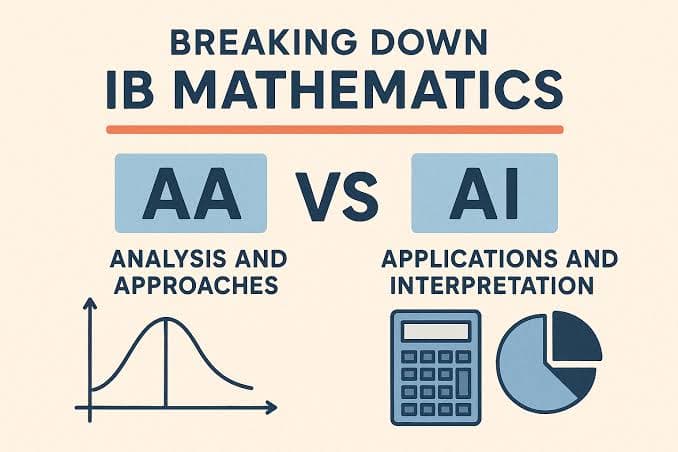
I've read multiple Math AI IAs online and the pattern that shows up again and again has nothing to do with whether the student is "good at maths." It's topic choice. Specifically, choosing a topic that lets the syllabus do the talking instead of you.
What the IA is actually rewarding in AI
Every Math IA — AA or AI, SL or HL — is marked against the same five criteria: Presentation, Mathematical Communication, Personal Engagement, Reflection, and Use of Mathematics. But the way AI students are expected to satisfy those criteria is different from AA, and that difference is exactly where most AI students undersell themselves.
AA explorations are usually built around a piece of pure structure like a proof, a pattern, an abstract result. AI explorations are meant to be built around a real context: a dataset, a phenomenon, a decision. The subject guide is explicit that AI is about mathematics in the world.
When an AI student picks a topic that's really just an AA-shaped proof wearing a real-world costume — "I will use derivatives to prove the optimal shape of a can" with no actual can, no actual data, no actual constraints — the exploration reads as thin, because it's answering the wrong course's question.
The topic-choice trap
Here's the trap in practice: a student picks something that sounds applied — optimizing a sports strategy, modelling population growth, predicting exam scores — and then does all the mathematics with either a formula pulled straight from a textbook or a tiny, made-up dataset that was never really investigated. The maths might be technically correct, but Personal Engagement and Use of Mathematics both suffer, because there's no evidence the student actually worked the real-world side of the problem: no real data collected or sourced, no discussion of why the model's assumptions might fail, no comparison against what actually happened.
A much stronger version of the same idea does three things differently:
It uses a real dataset, not an invented one. Whether that's data you collect yourself (say, tracking your own runs, matches, or a small experiment) or data sourced from a public dataset with a citation, real data is messier than a made-up one, and that messiness is where the interesting mathematics livese.
It shows the technology doing real work, not decoration. AI HL explicitly expects proficiency with your GDC or software as part of the investigation itself, running regressions, testing multiple models, visualizing residuals, not just producing a graph at the end to illustrate a result you already got by hand. Examiners are specifically looking for genuine use of technology to explore the problem, not to present it.
It interprets the answer back into context. A regression coefficient or a probability isn't the end of an AI exploration — it's the start of the interesting part. What does that number mean for the actual situation? Where does the model clearly break down? A strong conclusion says something like "the model predicts negative attendance past week 40, which is obviously impossible, meaning a linear model stops being appropriate beyond this range" — that single sentence does more for Reflection than a page of restated calculations.
A shortlist of topics that tend to work well
Not because they're "safe," but because they naturally force you into real data and real interpretation:
Modelling something you can actually measure yourself over time (a personal fitness metric, a small experiment, a local weather pattern) with regression and residual analysis
A Markov chain model of a game, sport, or process you understand well enough to sanity-check the output against reality
A statistical test applied to a genuinely collected dataset, with a discussion of why the assumptions of that test might not perfectly hold
A graph theory or network problem grounded in a real system (transport routes, social connections, logistics) rather than an abstract graph
The reflection habit that pays off disproportionately
The single highest-leverage sentence you can add to an AI exploration is a specific, technical statement about a model's limitation — not "this could be improved with more data," which examiners read dozens of times per session and treat as boilerplate, but something like "the model assumes independent trials, which likely doesn't hold here because consecutive results were correlated in my dataset, and a more appropriate approach would account for that correlation directly." That level of specificity is what separates Reflection scores that top out in the middle of the band from ones that reach the top.
If you're choosing your Math AI topic now, spend real time before you commit — not on the mathematics, but on making sure the context is one where you can genuinely get your hands on real numbers and have something honest to say about where the model holds and where it doesn't. That's the exploration AI is actually asking you to write.