
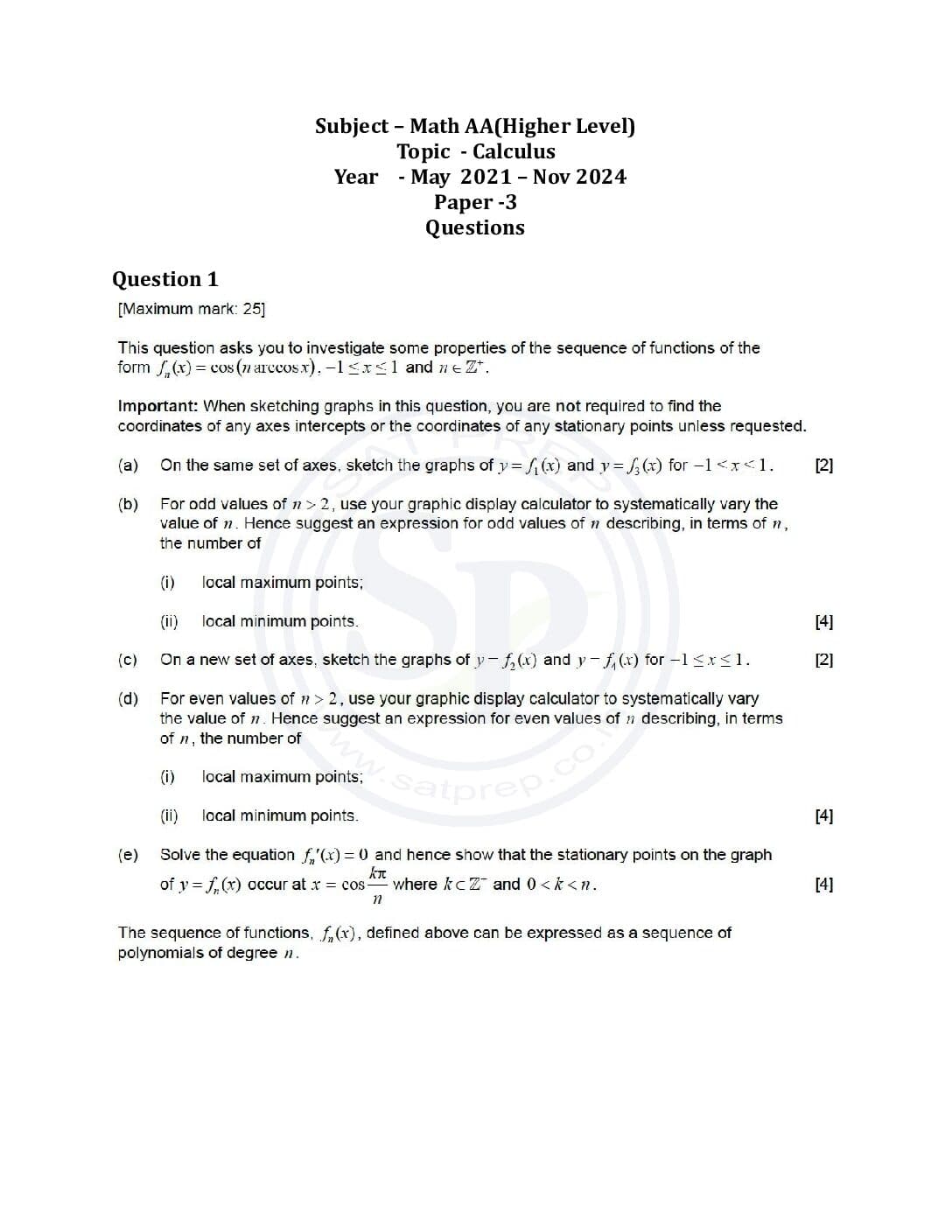
Every Math AA HL student I know has the same routine in the run-up to exams: grind Paper 1, grind Paper 2, and treat Paper 3 as an afterthought.
"it's only one paper, I'll figure it out closer to the date."
Paper 3 isn't a bonus round. It's the paper that separates people who know the syllabus from people who can actually think in it, and it's worth understanding early rather than three weeks before finals.
What Paper 3 actually is
Paper 1 and Paper 2 are HL-and-SL-shaped: a set of shorter, mostly independent questions covering the breadth of the syllabus, one non-calculator and one calculator. Paper 3, which only HL students sit, is different in kind, not just in difficulty. It consists of two extended, structured problems, each one built around a single idea that you have to explore, extend, and generalize across multiple parts that often end in a part you haven't explicitly been taught, where you're expected to spot the pattern and prove it.
That last bit is the whole point of the paper. Paper 3 is designed to test mathematical exploration under exam conditions: given a scaffolded problem, can you notice a pattern, form a conjecture, and justify it the way a mathematician would? It rewards the same instincts your Internal Assessment rewards, just compressed into 60 minutes and marked question by question instead of holistically.
Why students underrate it
Three reasons, from what I've seen in my own cohort:
It feels like "extra" content. Because SL students don't sit it, HL students can mentally file Paper 3 as a smaller, secondary component when in most schools it carries the same weighting share as a third of your total mark, alongside Papers 1 and 2.
Past papers are less abundant. There are simply fewer Paper 3s in circulation than Paper 1/2 papers, so students under-practice the format relative to how much they practice standard questions.
The skill it tests isn't taught directly. No one gives you a unit called "spotting patterns in unfamiliar sequences of subquestions." You either build the instinct through deliberate practice, or you meet it cold in the exam.
How to actually prepare for it
Work through every available past Paper 3 in full, not just the parts you find comfortable. The value of Paper 3 practice isn't in the final answer, it's in watching how each part sets up the next. Redo a paper a second time two weeks later without looking at your first attempt and you'll notice the structure much faster the second time, which is exactly the transfer you want on exam day.
Practice writing the "why", not just the "what." On Paper 1 and 2, a correct final answer often earns most of the marks. On Paper 3, markschemes are far more generous to a well-reasoned partial argument than to an unjustified correct number. Get in the habit of narrating your reasoning in full sentences as you work through practice problems. For example, "this suggests that... which would mean... so by induction...". That's the register examiners are marking against.
Treat the last part of each question as a mini investigation. The final subpart of a Paper 3 question is almost always the generalization: prove this holds for all n, extend this to three dimensions, show this converges. Don't skip past it in practice just because it looks unfamiliar; It actually is the highest-value part of the paper precisely because most students give up on it.
Build a "toolkit" page, not a formula sheet. Rather than re-memorizing what's already in the formula booklet, keep a page of techniques: proof by induction, proof by contradiction, recognizing a disguised geometric or arithmetic sequence, recursive definitions, how to handle a piecewise-defined pattern Paper 3 rewards recognizing which tool a problem is quietly asking for (You can find a resource to help yourself on my profile to get inspired) .
Time yourself in halves, not as one block. Sixty minutes for two questions means roughly 30 minutes each, but the two questions are rarely equal in difficulty. Practicing under a strict half-time split trains you to recognize early when a question is running long, so you can bank partial marks and move on rather than losing ten minutes chasing one stubborn part.
The mindset shift that actually helped me
The thing that changed my Paper 3 performance wasn't more content review. It was reframing the paper as a conversation with the examiner rather than a test to survive. Every subpart is a hint for the next one. If part (a) asks you to compute three terms of a sequence and part (b) asks you to conjecture a general formula, the exam is telling you to look for a pattern in your part (a) answers before you touch part (b). Reading the paper that way, as a guided investigation instead of a gauntlet, is what Paper 3 is actually testing.
If Math AA HL is your subject, don't leave Paper 3 for the last night. Add one past paper into your rotation every couple of weeks starting well before study leave, and by the time exams arrive, the format that used to feel unfamiliar will feel like the most predictable paper of the three.